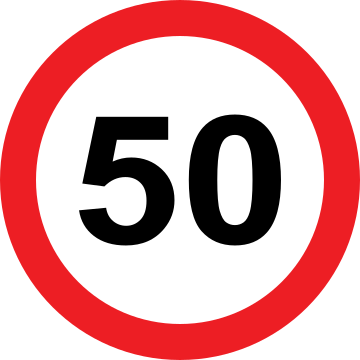
Speed Limit 50 Sign
Written and checked bySignalPe Desk· Editorial Desk
Shape: Circular (octagonal for Stop, inverted triangle for Give Way) · Colour: White with red border (prohibitory); blue with white symbol (positive mandatory, e.g. compulsory turn, keep left)
The maximum permitted speed on this stretch is 50 km/h.
What It Means
Speed limit signs are circular with a red border displaying a number — that number is the maximum speed in km/h permitted on that road for all vehicles. The 50 km/h limit is common within city limits. Other common limits: 30 km/h in school/hospital zones, 40 km/h on some urban roads, 100 km/h on National Highways for cars, and 120 km/h on expressways for light vehicles. Heavy goods vehicles are limited to 80 km/h on NHs and expressways (MoRTH S.O. 2188(E), 2018).
📍 Where You'll See It
Entering urban areas from highways, near schools and hospitals, on roads with pedestrian activity, construction zones, and sharp curves.
✅ What You Must Do
Reduce speed to the posted limit before reaching the sign. Maintain that speed until you see an "End Restriction" sign or a new speed limit sign.
⚠️ Common Mistake
Slowing down only when you see the sign, then accelerating past it. The limit applies to the entire stretch until changed.
⚖️ Legal Note
Violation: Sec. 183 MV Act. LMV: ₹1,000–₹2,000. Heavy vehicle: ₹2,000–₹4,000. Third offence: licence suspended.
Frequently Asked Questions
What does the Speed Limit 50 sign mean?
Where will I see a Speed Limit 50 sign?
What should I do when I see a Speed Limit 50 sign?
Know a Driver Who Ignores This Sign?
Share this page. Awareness is the first step to safer roads.
Other Mandatory Signs
Stop
You must bring your vehicle to a complete halt at the stop line.
Give Way
Yield to all vehicles and pedestrians on the road you are entering.
No Entry
Entry of all vehicles is strictly prohibited in this direction.
No Parking
Parking of any vehicle is not permitted in this area.
No Stopping
Neither stopping nor parking is allowed at any time, for any reason.
No U-Turn
Making a U-turn to reverse your direction of travel is prohibited here.