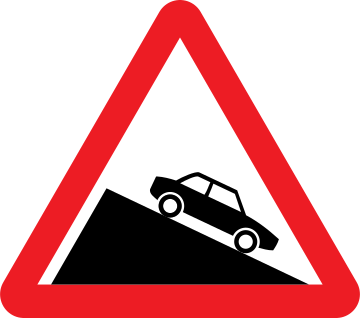
Steep Descent Sign
Written and checked bySignalPe Desk· Editorial Desk
Shape: Equilateral triangle (pointing up) · Colour: Yellow/white with red border
A steep downhill gradient lies ahead.
What It Means
Steep descent signs are placed before downhill sections where brake fade is a serious risk. Continuous braking on a long descent heats brake pads and discs to the point where braking effectiveness is dramatically reduced — a phenomenon called brake fade that has caused numerous bus and truck accidents in India's ghat sections. The correct technique is to engage a lower gear and use engine braking, applying the footbrake only intermittently.
📍 Where You'll See It
On ghat sections, hill roads in the Western and Eastern Ghats, Himalayas, and wherever significant downhill grades exist.
✅ What You Must Do
Engage a lower gear before the descent. Do not ride the brake continuously. If brakes overheat, pull over at the nearest escape ramp or wide shoulder.
⚠️ Common Mistake
Descending in neutral or high gear with continuous brake application. This is how brake fires and runaway vehicles happen.
⚖️ Legal Note
Truck/bus drivers ignoring descent procedure can be charged under Bharatiya Nyaya Sanhita Sec. 106(1) (causing death by negligence; formerly IPC 304A) in fatal accidents.
Frequently Asked Questions
What does the Steep Descent sign mean?
Where will I see a Steep Descent sign?
What should I do when I see a Steep Descent sign?
Know a Driver Who Ignores This Sign?
Share this page. Awareness is the first step to safer roads.
Other Cautionary Signs
School Ahead
A school is nearby. Children may be crossing or walking on or near the road.
Pedestrian Crossing
A pedestrian crossing (zebra crossing) is ahead. Pedestrians have right of way.
Narrow Road Ahead
The road narrows significantly ahead — from both sides. Reduced width for the oncoming stretch.
Steep Ascent
A steep uphill gradient lies ahead.
Slippery Road
The road surface is slippery — due to rain, oil, loose gravel, or mud.
Road Hump
A speed breaker or road hump is present on the road ahead.